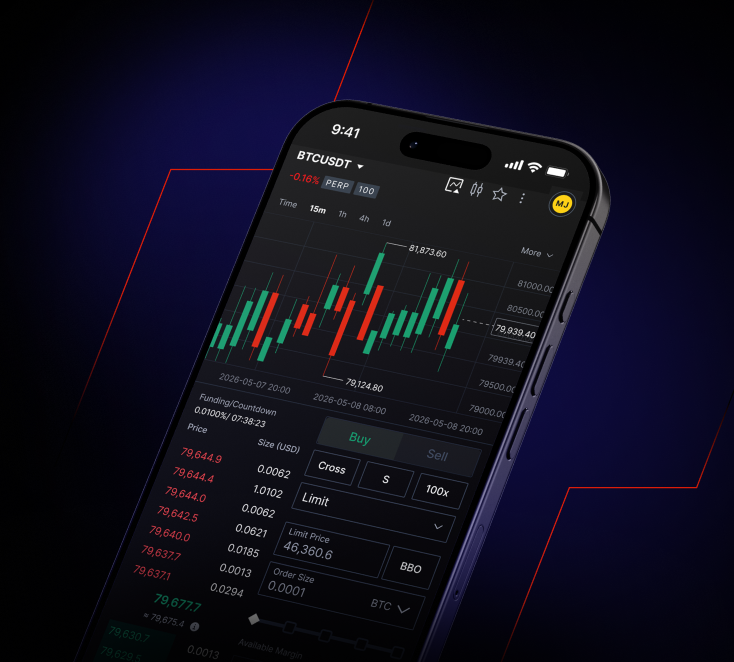
Most discussion of BitMEX trading still defaults to the platform's derivatives heritage — perpetual swaps, high leverage, the funding rate. That picture is incomplete in 2026.
The same account now opens onto a working spot venue, a transparent 8-tier fee ladder, multi-asset collateral, and a custody architecture that has gone eleven years without a client-fund breach.
In one page.
Founded 2014. Operating entity HDR Global Trading Limited. The venue that invented the perpetual swap.
BitMEX has run continuously since 2014. The operating entity is HDR Global Trading Limited, registered in Seychelles, founded by Arthur Hayes, Ben Delo and Samuel Reed. The venue introduced the perpetual swap format in 2016 — every major derivatives exchange that followed copied the design — and has stayed under the same legal structure for more than a decade.
In 2026 the product surface includes spot, crypto perpetual swaps, fixed-expiry futures, TradFi Perps (stocks, commodities, FX), copy-trading guilds, reverse copy trading, built-in grid bots, hedge mode and Multi Asset Margining across USDT, USDC, ETH and XBT. The rest of this article concentrates on the spot side. Derivatives products are not available to UK retail consumers, so the practical entry point for this audience is direct purchase and sale of supported coins at 1x with no leverage, no funding rate and no liquidation risk.
What can actually be traded.
The spot listings cover the coins most traders look for. BTC and ETH against USDT are the two deepest books and the cleanest places to start. The larger-cap altcoins are listed alongside them, with a handful of newer additions rotated in through the year. Quote currency on most pairs is USDT, with USDC available on selected listings. Pair availability does shift over time, so the live trading interface is the only reliable reference when planning a specific trade.
The venue does not run a B-Book.
The exchange does not warehouse risk against client trades and does not take the other side of orders. Pricing on the book is set by other participants. For a reader coming from a CFD or spread-bet platform where the broker effectively quoted the price internally, this is a structurally different relationship — every fill comes from another trader posting on the book, and the venue earns a trading fee on each match rather than a spread layered on top of the position.
No centrally-quoted spread on top of the book.
Some retail platforms apply a markup over the public mid before the order even reaches the book. That layer does not exist here; the cost paid to enter and exit a spot position is the fee on each side, plus any slippage relative to the mid at the moment of execution.
Depth behaviour splits roughly into two groups. The flagship pairs hold tight spreads at the top of book and absorb retail-sized clips at the screen price during normal hours. Mid-cap and smaller listings show the same tight spread on the immediate top but thin out quickly across the next several layers. The practical implication is that a market order on a thin pair can sweep through more depth than the screen suggests, while the same order on a flagship pair clears cleanly.
The full ticket.
No extras to enable. Limit and market handle most retail size; the slippage cap is the one feature worth knowing about regardless of size.
Place at a chosen price.
Sits on the book at a level you specify until filled or cancelled. The default tool when the entry price matters more than getting filled now.
Immediate fill, with a cap.
Best available price now. Max Slippage Protection is the difference between an entry near screen price and one several percent worse on a fast move.
Stop limit · stop market.
Triggers above or below the current price. Used either to stop out of a position or to enter a breakout. Both flavours available on spot.
Limit · market into strength.
Closing orders set at a target. Same two flavours: pay slippage for certainty of fill, or queue at a level and accept the chance of being skipped.
Tracks favourable moves.
Exit that follows price at a defined distance. Useful for letting a winner run without manually moving the stop.
For breaking up size.
Hidden orders sit on the book without showing depth. Iceberg breaks a larger order into displayed slices and refills as each slice fills — the engine handles the refill.
An 8-tier ladder, plainly stated.
Fees are where third-party coverage most often drifts from the live schedule, so this sticks closely to the current ladder.
Tier placement is set by the higher of two conditions: BMEX tokens staked or 30-day trading volume in USD. A user who has staked enough BMEX to qualify for VIP 1 sits on VIP 1 even with no trading volume that month.
| Tier | BMEX Staked | 30-day Volume (USD) | Spot Maker | Spot Taker |
|---|---|---|---|---|
| Regular 1 | ≥ 0 | ≥ 0 | 0.0500% | 0.0500% |
| Regular 2 | ≥ 1,000 | ≥ 1,000,000 | 0.0500% | 0.0500% |
| Regular 3 | ≥ 10,000 | ≥ 2,500,000 | 0.0500% | 0.0500% |
| VIP 1 | ≥ 50,000 | ≥ 10,000,000 | −0.0025% | 0.0500% |
| VIP 2 | ≥ 150,000 | ≥ 25,000,000 | −0.0050% | 0.0500% |
| VIP 3 | ≥ 300,000 | ≥ 50,000,000 | −0.0075% | 0.0500% |
| VIP 4 | ≥ 750,000 | ≥ 100,000,000 | −0.0100% | 0.0500% |
| VIP 5 | ≥ 2,000,000 | ≥ 250,000,000 | −0.0150% | 0.0500% |
Working cost on a typical retail spot ticket — per side. Nothing else layered on top.
APY range on BMEX staking, depending on tier. Two ways to reach a tier — stake or volume.
Typical spread built into a domestic on-ramp's displayed price. The gap on a round trip is material once size is involved.
Four steps to a verified account.
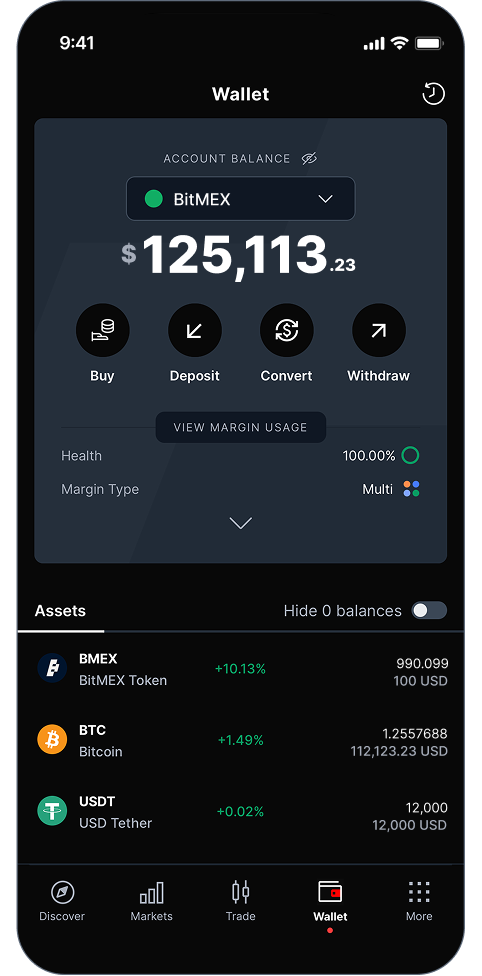
Registration uses email and password, or a Google or Apple sign-in. Identity verification is mandatory before any trading and runs through four steps. Most individual applications clear within hours. Anyone arriving from a 2020-era write-up expecting a no-KYC venue should treat that source as dated.
-
01
Government-issued photo ID
Passport, national ID card, or driving licence.
-
02
Selfie with a liveness check
A short video or camera capture used to match against the submitted document.
-
03
Confirmation of physical location
Typically cleared automatically through browser geolocation, with a government database lookup as the second route and a proof-of-address document as the fallback.
-
04
A short questionnaire
Trading experience, source of funds and the purpose of the account.
Funding happens in crypto. There is no GBP rail on the platform itself, so the standard route is to buy stablecoins or BTC on a domestic on-ramp and transfer them in. Multi Asset Margining means a USDT, USDC, ETH or XBT balance can be used directly across the platform without a manual conversion step — for a trader who keeps a stablecoin reserve and rotates into BTC or ETH on dips, that means routing a buy from a single balance pot rather than first converting between collateral assets.
Three choices.
Pick the pair.
BTC/USDT or ETH/USDT are the two most liquid spot pairs and the cleanest place to start. Smaller listings reward checking book depth before sending a market order.
Pick the order type.
Limit if the entry price matters more than getting filled now. Market if getting filled immediately matters more, with the slippage cap set to a tolerance you are comfortable with.
Set the size.
On spot this is straightforward — the size is whatever you want to hold, and the only cost is the fee on each side of the trade.
The screen confirms the gross order, the fee at the current tier and the net amount delivered into the balance. For limit orders, the ticket sits on the book until filled or cancelled; for market orders with a slippage cap, partial fills are possible if the book runs out of depth within the cap.
How client funds are held.
The part of the platform that does most of the heavy lifting on the trust question — and the part most often missed in coverage that focuses purely on fees and product surface.
Management uses MPC — multi-party computation. The private key is never assembled in one place at any stage. Signing happens through distributed shares held by separate parties, so no single device or operator ever holds the full key material. This removes the most common single-point-of-failure scenario in exchange custody.
Storage of client assets is 100% cold, with no hot-wallet exposure designed into the architecture. Customer balances are held segregated and are not lent out to other users.
Proof is published twice a week. The Reserves side uses signed messages from on-chain addresses. The Liabilities side uses a Merkle Sum tree — a modified Maxwell scheme — where each leaf carries a plaintext balance plus an HMAC256 commitment with a per-user nonce, and the root commits to the sum of all liabilities. The verifier code is open source so a technically inclined reader can run the verification independently.
Account-side: 2FA, withdrawal address whitelists, IP restrictions on API keys, PGP-encrypted email notifications. Small withdrawals process through an automated batch flow; larger or risk-flagged ones route to manual review.
Twice-weekly publication cuts the drift between reserves and liabilities from four weeks to a few days.
Three working defaults.
Without leverage, the worst-case loss is the position going to zero. That bounds the downside — it does not make a position safe.
Position sizing.
Sizing each spot ticket so a 50% adverse move would not change anything material about the rest of the portfolio is the working starting point. A coin can also delist, get hacked at the protocol level, or simply lose narrative — none of which a stop loss protects against.
Slippage cap.
The slippage cap on market orders is the single most useful execution control on smaller pairs. Setting a sensible cap before the trade is sent costs nothing if the book is healthy, and is the only thing standing between a normal fill and one several percent off-screen during a fast move.
Self-custody after.
Spot positions held for any length of time are usually safer in personal custody than on any exchange. Withdrawing to a hardware wallet for long-term holdings is a separate decision from where the trading happens — worth treating as a default for anything held beyond a few weeks.
What else sits on the account.
Background for a user who plans to stay on spot. Crypto and TradFi derivatives products are not available to UK retail consumers.
| Product | Detail |
|---|---|
| Spot | Direct buying and selling of supported coins, no leverage |
| Crypto Perpetual Swaps | Major pairs with leverage profiles set per instrument |
| Fixed-Expiry Futures | Quarterly and monthly contracts on the major pairs |
| TradFi Perps — Stocks | Equities and broad-market wrappers · up to 20× |
| TradFi Perps — Commodities | Gold, Silver, WTI, Brent · up to 25× |
| TradFi Perps — FX | EUR/USD, USD/JPY, GBP/USD, AUD/USD, USD/CHF, USD/CAD · up to 100× |
| Copy Trading (Guilds) | Native copy product with a Hyperliquid leaderboard integration |
| Reverse Copy Trading | Take the opposite side of strategies the platform flags as consistent losers |
| Trading Bots | Built-in grid bots, no API setup required |
| Multi Asset Margining | USDT, USDC, ETH and XBT all back positions on the same account |
| Hedge Mode | Long and short on the same instrument at the same time |
| BMEX Token + Staking | Fee discounts up to −75% versus base tier |
Where BitMEX is structurally different.
The comparison below picks parameters where BitMEX has a structural difference from other major venues, rather than line items where everyone is broadly equivalent.
| Parameter | BitMEX | Bybit | OKX | Binance (offshore) |
|---|---|---|---|---|
| Operating history | 11 yrs, zero client-fund losses | 7 yrs | 8 yrs | 8 yrs |
| Proof of Reserves cadence | Twice weekly · Merkle Sum tree · open verifier | Monthly | Monthly | Monthly |
| Custody architecture | MPC + 100% cold | Cold majority | Cold majority | Cold majority |
| Order book model | No B-Book · peer-to-peer matching | Order book | Order book | Order book |
| Multi-asset margining | USDT, USDC, ETH, XBT | Limited | Yes | Yes |
The "no B-Book" line carries more weight than it looks. It means the venue does not warehouse risk against client positions; matching is peer-to-peer and revenue comes from trading fees on each side. For a user coming from a retail broker where the platform was effectively the counterparty to the trade, this is a different commercial alignment.
A small number of structural points.
The case for BitMEX trading on spot in 2026 sits on a small number of structural points.
- ·Eleven years of continuous operation without a custody breach.
- ·MPC plus 100% cold storage.
- ·Proof of Reserves twice a week with an open-source verifier that lets each user check their own balance is included.
- ·A transparent 8-tier fee ladder where a fresh account pays 0.05% per side and the rebate side opens up from VIP 1.
- ·Multi-asset collateral that removes the conversion step between USDT, USDC, ETH and XBT.
- ·An order ticket with the slippage cap, hidden and iceberg orders most retail platforms do not expose at all.
The platform is not a beginner-friendly default and does not present itself as one. For a reader who wants a venue with a long custody track record, a serious order ticket on the spot side and pricing that does not hide a spread inside the displayed price, it is a credible option.
What traders say.
A selection of feedback from people who trade on BitMEX day to day — execution, fees, support and custody, in their own words. Reviews are moderated before publication.
The mobile app is a genuine lifesaver
Honestly the BitMEX mobile app is a lifesaver when I'm away from my desk — execution is snappy even on 5G.
Fair funding rates on the BTC perps
I mostly use BitMEX for the BTC perpetuals. Funding rates are pretty fair compared to other exchanges I've tried.
Support sorted my 2FA in ten minutes
Shoutout to the support team at BitMEX — had an issue with my 2FA and they cleared it up in like ten minutes flat.
No lag when the market moves fast
Finally an exchange that doesn't lag when BTC moves 2k in five minutes. The BitMEX engine is built different.
Still the king for BTC perps
BitMEX is still the king for BTC perps. The volume is always there when you need to exit a position fast.
Getting paid to provide liquidity
Love the maker rebates on BitMEX. Literally getting paid to provide liquidity is a nice bonus.
Rebates that add up over a quarter
Maker rebates aren't huge but they accumulate. I run a market-making strategy and over three months it's made a meaningful difference to my net PnL.
Noticeably faster fills on my ETH trades
Switched my ETH leverage trades to BitMEX recently. The execution speed is noticeably better.
Copy trading you can actually verify
Copy trading on BitMEX is actually legit. I like that you can see the real PnL of the leaders before committing.
The blog is worth a read for macro
The BitMEX blog actually has some good alpha sometimes — worth a read if you trade macro.
Help docs that actually explain funding
Understanding funding rates took me a while, but the BitMEX help docs actually explain the mechanics well. Most platforms just show you a number without context.
Execution matters more than the fee rate
Scalping here makes sense because execution doesn't lag. In fast markets that's not obvious to new traders, but it matters more than the fee rate.
Eleven years and not a penny lost
I've been trading on BitMEX since 2015 and they never lost a penny of client funds, even during the craziest black-swan events. That security track record is why I keep my main stack here.
Built for serious size
BitMEX is just better for serious size and managing high-margin positions.
Leave a review
Traded on BitMEX? Share your experience. Submissions are moderated before they appear.
It's now queued for moderation and will appear here once approved.